Ground Motion Record Selection to Eurocode 8 (CEN 2024) with the Djura Record Selector
The record selector used in this post is described in Shahnazaryan, Ozsarac and O'Reilly (2025), COMPDYN 2025, doi:10.7712/120125.12444.25126.

- What CEN 2024 changes for record selection
- Selecting records in the app
- What the selector checks
- Worked example
- Further reading
- ::blog-faq
- References
What CEN 2024 changes for record selection
CEN 2024 is the second generation of Eurocode 8 Part 1-1 (EN 1998-1-1:2024). Compared with CEN 2004, three changes affect how you select records:
- The spectrum starts from spectral accelerations, not PGA. The main hazard input is the reference spectral acceleration of the plateau, Sα,ref.
- The site can be described in two ways. Either by a soil class from A to F, or by the shear-wave velocity of the soil deposit, Vs,H, and the depth to bedrock, H800, from which the class follows.
- The selection rules in Annex D are stricter. At least 7 records, a band on the mean spectrum, a minimum for every single record, a rule for the vertical component and no more than two records from the same earthquake.
The record selector handles all of this for you. The steps below show where each input goes.
Selecting records in the app
Step 1: open Code-Based Selection
Open the Djura record selector and go to Uniform Hazard Selection, then Code-Based Selection. In the drop-down menu, choose Eurocode 8 - CEN (2024). The CEN 2024 form opens on the left, and the plots appear on the right once you create the target.
Step 2: set the advanced input
The Advanced Input page holds the settings shared by all codes. Set them first, because the number of components decides whether the form shows the vertical component.
- Number of ground motion components: 1, 2 or 3. With 3, each record has two horizontal components and one vertical component, and the vertical component is selected and checked too.
- Maximum number of records per event: 2 by default for CEN 2024. The app does not accept more, because Annex D allows no more than two records from the same earthquake.
- Ground motion record database: ESM (the default), NGA-West2 or both.
- Scaling of horizontal and vertical components: coupled scaling uses one factor for all components; de-coupled scaling (the default) lets the vertical factor differ.
- Error metric, penalty factor and error weight of the vertical components, which tune how the selector ranks candidate sets.
- Criteria for earthquake rupture parameters, such as magnitude or faulting mechanism, and earthquakes to leave out.
Step 3: fill in the CEN 2024 inputs
The form is split into cards. Hover over the information icons in the app for a short description of each input.
| Card | Input | Default |
|---|---|---|
| General | Input option: spectral parameters, or a target spectrum file | Spectral parameters |
| General | Number of records | 11 |
| Hazard | Sα,ref [g], the reference spectral acceleration for site category A | 0.2 |
| Hazard | γLS,CC, the performance factor | 1.0 |
| Hazard | Topography type, T1 (flat ground) to T4 (steep ridges) | T1 |
| Soil Conditions | Soil class A to F, or the site's Vs,H [m/s] and H800 [m] | Soil class C |
| Horizontal Component | Predominant period T1 [s], or the bounds of the matching period range | T1 = 1.0 s |
| Horizontal Component | Minimum and maximum scaling factor | 0.5 and 2.0 |
| Vertical Component | Vertical period T1,v [s], or the bounds of the matching period range | T1,v = 0.2 s |
| Vertical Component | Minimum and maximum scaling factor | 0.2 and 5.0 |
A few notes on the inputs:
- If you give the predominant period, the selector matches the spectra from 0.2T to 1.5T, as Annex D asks. If you give period bounds instead, they are used as they are.
- With Vs,H and H800, the selector classifies the site for you. H800 is optional and defaults to 30 m.
- The default scaling limits of 0.5 and 2.0 for the horizontal components are those Annex D recommends for geotechnical applications and highly non-linear structural response. You can change them for other analyses.
- If you already have a target spectrum, for example from a site-specific hazard study, choose Target spectrum file and upload it instead of the spectral parameters.
Click Save Changes below the form before moving on.
Step 4: create the target spectrum
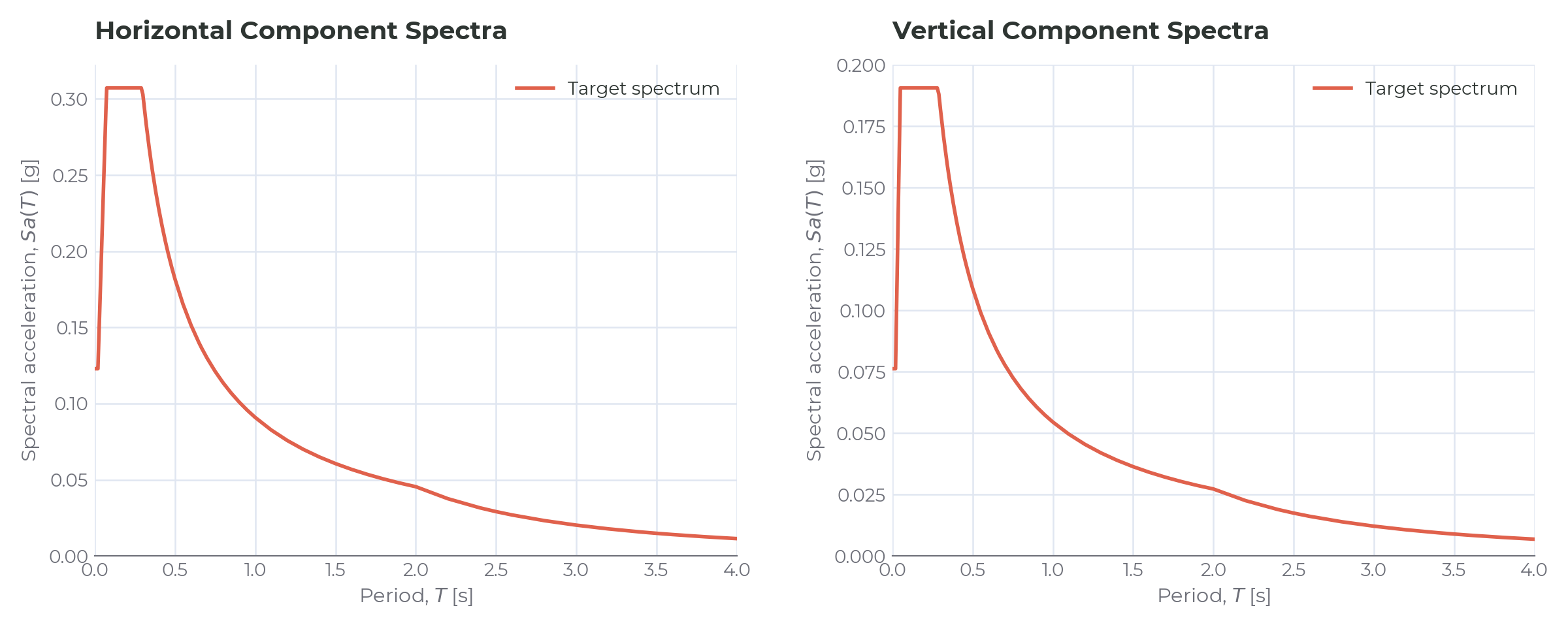
Click the target button on the right (the bullseye icon) to create the target spectrum. The app draws the horizontal and, with three components, the vertical elastic spectrum of CEN 2024 for your inputs. The plots are interactive: hover to read values, zoom in, or save the figure.
Step 5: perform the selection
Click Perform record selection. The selector searches the database for the set of records that best matches the target while meeting the Annex D rules, scales each record and shows:
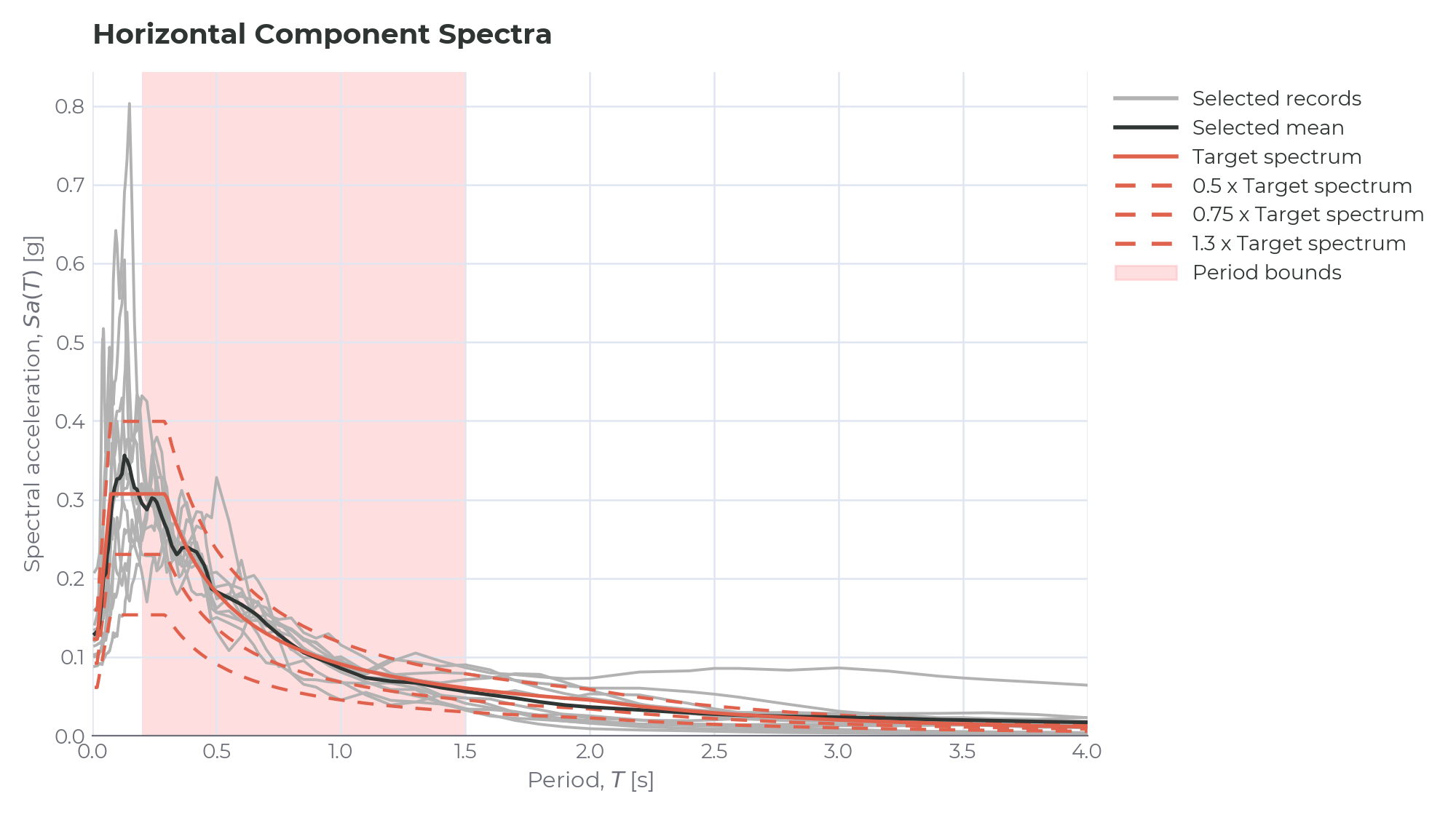
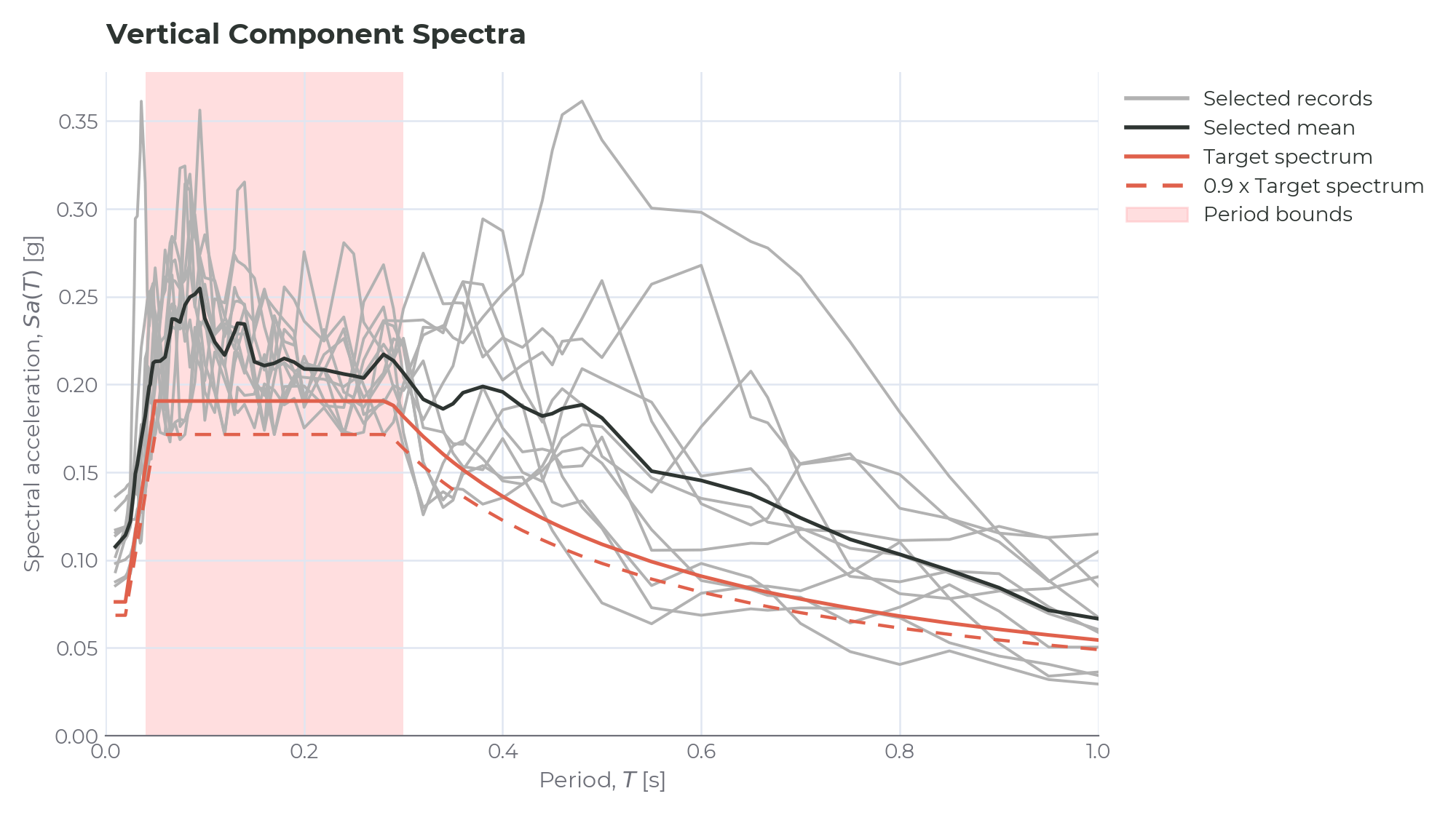
- the Horizontal Component Spectra and, with three components, the Vertical Component Spectra: every scaled record, their mean, the target, the factored targets used by the rules and the matching period range;
- the table of selected records below the plots, with the scaling factors and the metadata of each record.
If the selector cannot find enough records, the app asks you to relax the conditions, for example the scaling limits or the rupture parameter criteria.
What the selector checks
The table summarises the Annex D rules and what the record selector does with each of them.
| Rule | CEN 2024 | In the record selector |
|---|---|---|
| Number of records | At least 7; at least 3 for low and very low seismic action classes | Needs at least 3 records; choose 7 or more unless the seismic action class is low or very low |
| Period range | 0.2T to 1.5T | Set from the predominant period you enter |
| Mean spectrum | Between 0.75 and 1.3 times the target, and on average at least 0.95 times the target | Applied during the selection, drawn as 0.75 and 1.3 x target |
| Each record | Not below 0.5 times the target | Applied during the selection, drawn as 0.5 x target |
| Vertical component | Each record not below 0.9 times the vertical target from 0.2Tv to 1.5Tv | Applied when three components are selected, drawn as 0.9 x target |
| Records per earthquake | No more than two | Limited to 2 in the advanced input |
| Scaling | Amplitude scaling, with factors between 0.5 and 2 for geotechnical applications or highly non-linear response | Amplitude scaling, within the limits you set |
| Near-source sites | 30% of the records pulse-like | Not checked; restrict the candidates with the rupture parameter criteria |
CEN 2024 also allows a uniform hazard spectrum from a site-specific hazard study, or a conditional spectrum, in place of the code spectrum. Upload the former as a target spectrum file; for the latter, see conditional spectrum record selection.
Worked example
The example uses the default inputs of the app: 11 records with three components from the ESM database, soil class C, Sα,ref = 0.2 g, γLS,CC = 1.0, topography T1, T1 = 1.0 s and T1,v = 0.2 s, with scaling factors between 0.5 and 2.0 for the horizontal components and between 0.2 and 5.0 for the vertical ones.
Horizontal components. The selected records match the target over 0.2 to 1.5 s, the shaded range:
- the mean spectrum stays between 0.85 and 1.12 times the target, inside the 0.75 to 1.3 band, with an average ratio of 0.985 (Annex D asks for at least 0.95);
- no record falls below 0.5 times the target;
- the scaling factors range from 0.63 to 1.85, within the limits of 0.5 and 2.0.
Vertical components. The vertical components are matched from 0.04 to 0.3 s, that is 0.2Tv to 1.5Tv for Tv = 0.2 s. Their mean is 1.07 to 1.34 times the vertical target over this range, and the vertical scaling factors range from 0.73 to 3.39, within the limits of 0.2 and 5.0.
The selected records. The 11 records come from 8 earthquakes between 1979 and 2023, with magnitudes from 5.4 to 7.7, and no earthquake contributes more than two records. The table shows them as the app lists them below the plots, without the file names of the components.
| Database | RSN | Event Name | Event Year | Station Name | Scaling Factor (H) | Scaling Factor (V) | Magnitude | Vs30 [m/s] | Rjb [km] | Rrup [km] | Duration [s] | Time Step [s] | Usable Maximum Period [s] | Mechanism | Ground Motion Component(s) |
|---|---|---|---|---|---|---|---|---|---|---|---|---|---|---|---|
| ESM | 31614 | Central Italy | 2016 | IT-CSC | 1.847 | 2.585 | 5.40 | 698.00 | 16.74 | 19.09 | 46.37 | 0.0050 | 12.5 | normal fault | H1, H2, V |
| ESM | 42377 | Albania | 1979 | EU-ULO | 1.704 | 3.039 | 5.40 | 396.14 | n/a | n/a | 18.32 | 0.0050 | 5.0 | reverse fault | H1, H2, V |
| ESM | 35394 | Irpinia | 1980 | IT-ALT | 1.769 | 3.387 | 6.90 | 1018.00 | 18.27 | 18.40 | 66.49 | 0.0050 | 6.7 | normal fault | H1, H2, V |
| ESM | 35736 | Southern Italy | 1998 | IT-VGG | 1.695 | 1.771 | 5.60 | 418.00 | n/a | n/a | 21.51 | 0.0050 | 3.3 | normal fault | H1, H2, V |
| ESM | 32680 | Central Italy | 2016 | IV-TRE1 | 1.477 | 1.648 | 6.50 | 731.47 | 42.28 | 42.28 | 100.00 | 0.0050 | 25.0 | normal fault | H1, H2, V |
| ESM | 21576 | Pazarcik, Turkey | 2023 | TK-2711 | 1.140 | 1.330 | 7.70 | 358.00 | 34.61 | 37.67 | 105.00 | 0.0050 | 50.0 | strike-slip fault | H1, H2, V |
| ESM | 42405 | Northwestern Balkan Peninsula | 1979 | EU-PET | 0.985 | 1.279 | 6.20 | 776.42 | 9.93 | 18.77 | 25.68 | 0.0050 | 5.0 | reverse fault | H1, H2, V |
| ESM | 21638 | Pazarcik, Turkey | 2023 | TK-2704 | 0.933 | 1.342 | 7.70 | 365.00 | 69.94 | 73.04 | 105.00 | 0.0050 | 33.3 | strike-slip fault | H1, H2, V |
| ESM | 42496 | Duzce | 1999 | A-D0531 | 0.627 | 1.554 | 7.30 | 1035.45 | 0.92 | 1.07 | 41.39 | 0.0050 | 20.0 | strike-slip fault | H1, H2, V |
| ESM | 35397 | Irpinia | 1980 | IT-BRN | 0.646 | 0.731 | 6.90 | 403.00 | 37.70 | 37.76 | 78.83 | 0.0050 | 6.7 | normal fault | H1, H2, V |
| ESM | 32676 | Central Italy | 2016 | IV-TERO | 1.498 | 1.761 | 6.50 | 912.00 | 27.87 | 27.87 | 61.38 | 0.0050 | 25.0 | normal fault | H1, H2, V |
Further reading
- Code-based record selection to a uniform hazard spectrum: the walkthrough of the selector for all supported codes.
- Conditional spectrum record selection explained: the hazard-consistent alternative allowed by CEN 2024.
- PGA vs spectral acceleration: why the new spectrum starts from spectral accelerations.
Try it in the Djura record selector, see the online platform, or get in touch about our risk engineering consulting services.
Frequently asked questions
How do I select ground motion records to Eurocode 8 2024?
In the Djura record selector, open Code-Based Selection, choose Eurocode 8 - CEN (2024), enter the hazard, soil and period inputs, create the target spectrum and click Perform record selection. The selector picks and scales the records to the CEN 2024 spectrum following the Annex D rules.
How many ground motion records does Eurocode 8 2024 require?
CEN 2024 asks for at least 7 records, or at least 3 for low and very low seismic action classes. The record selector does not run with fewer than 3 records.
Can I select the vertical component of ground motion to CEN 2024?
Yes. Set the number of ground motion components to 3 in the advanced input, then give the vertical period or the vertical period range and the vertical scaling limits in the CEN 2024 form. The selector creates the vertical target spectrum and selects the vertical components with the horizontal ones.
Do I need VsH and H800 to use the CEN 2024 spectrum?
No. You can give a soil class from A to F instead. If you give VsH and H800, the selector classifies the site for you, and H800 defaults to 30 m when it is left empty.
How many records from the same earthquake are allowed in CEN 2024?
No more than two. The record selector limits the maximum number of records per event to 2 for CEN 2024.
Can I use my own target spectrum with CEN 2024 in the record selector?
Yes. Choose Target spectrum file as the input option and upload the spectrum, for example a uniform hazard spectrum from a site-specific hazard study, instead of entering the spectral parameters.
References
- Shahnazaryan, D., Ozsarac, V., & O’Reilly, G. J. (2025) "Djura ground motion record selector: a software solution for earthquake engineering" COMPDYN 2025. DOI: 10.7712/120125.12444.25126
- CEN (2024). Design of Structures for Earthquake Resistance - Part 1-1: General Rules, Seismic Actions and Rules (EN 1998-1-1:2024) (Comité Européen de Normalisation).